Best Suburbs of Chicago to Live In 2026 — Data, Not Opinions
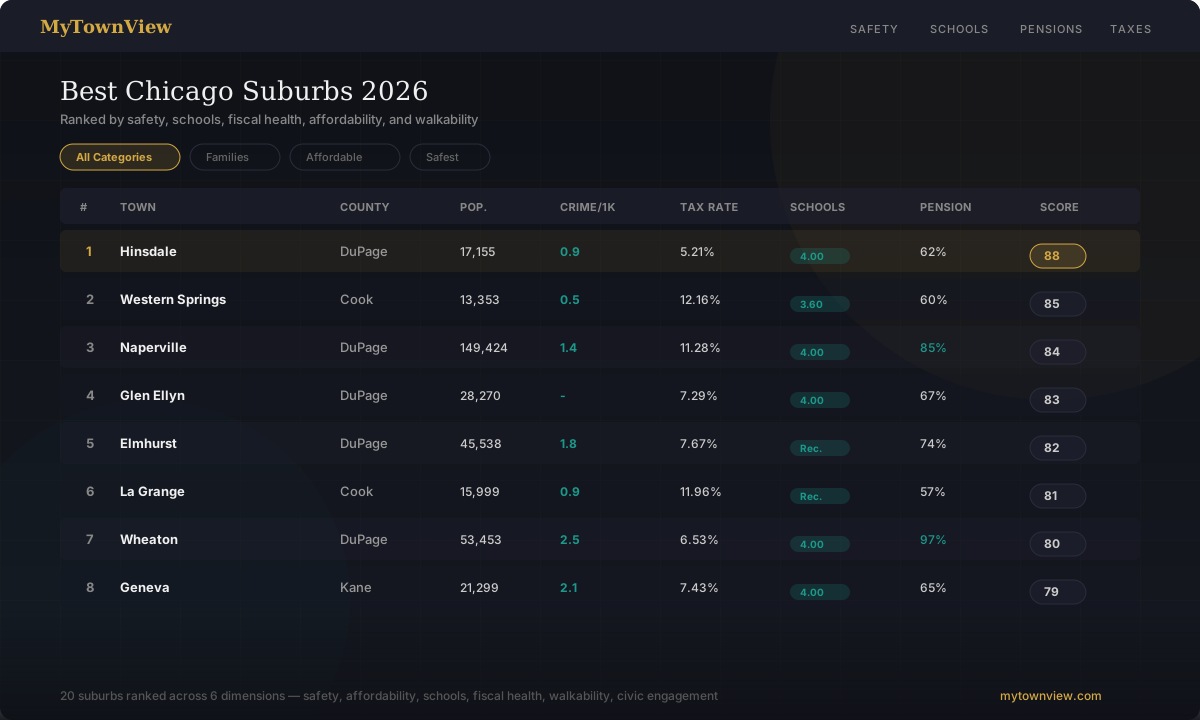
Correction — April 13, 2026 at 8:01 PM CT: We identified a SQL aggregation error in our original data pipeline that affected municipalities spanning multiple counties. Crime rates, population figures, home values, and median incomes were misstated for several towns in the original version. School financial profile scores for Western Springs and Wheaton were also incorrect. We have corrected all figures against our verified database, re-run the ranking model, and updated this post accordingly. The methodology section now accurately reflects how our scoring system works. We take data accuracy seriously — if you spot anything else, let us know.
Every year, a handful of magazines and real estate blogs publish their "Best Suburbs of Chicago" lists. They're heavy on adjectives — "charming," "vibrant," "family-friendly" — and light on evidence. A few quote median home prices. Some mention school ratings. Almost none tell you how healthy your town's pension fund is, whether the village board actually meets in public, or how your property tax bill compares dollar-for-dollar to the next town over.
We think you deserve better than vibes.
MyTownView tracks real municipal data across 1,278 Illinois municipalities — meeting minutes, crime statistics, property tax rates, school district finances, pension funded ratios, and more. So instead of asking a real estate agent which suburb "feels nice," we built a scoring model using ten dimensions of publicly available civic data across two composite indices, applied it to every Chicago-area suburb, and ranked them.
No sponsorships. No ad placements. No "Top 10" lists padded with towns that bought a feature. Just data.
Here's what we found.
How We Scored Every Suburb
We evaluated suburbs across two composite indices — Fiscal Health and Quality of Life — each built from five data-driven components. The overall score is the simple average of the two composites, each scored 0–100. A detailed methodology is at the bottom of this post, but here's the summary.
Fiscal Health (0–100)
Fiscal Health measures whether a town is living within its means or deferring costs to future taxpayers. Five components:
| Component | Weight | What It Measures |
|---|---|---|
| Pension Health | 25% | Average police and fire pension funded ratio — the single best indicator of long-term fiscal discipline |
| Budget Balance | 20% | Revenue-to-expenditure ratio — is the town running a surplus or a deficit? |
| Revenue Capacity | 20% | Revenue per capita — does the town have the tax base to fund services? |
| Tax Burden | 20% | Composite property tax rate (inverted) — lower rates score higher |
| Revenue Growth | 15% | Year-over-year revenue change — is the fiscal trajectory improving or declining? |
Quality of Life (0–100)
Quality of Life captures the day-to-day experience of living in a place. Five components:
| Component | Weight | What It Measures |
|---|---|---|
| Safety | 25% | All reported offenses per 1,000 residents — the broadest available measure of public safety |
| Education | 25% | Enrollment-weighted average ELA and math proficiency across all school districts serving the municipality |
| Prosperity | 20% | Median household income from the American Community Survey |
| Housing Stability | 15% | Homeownership rate — communities with higher ownership tend to have more stable property values and civic investment |
| Environmental Quality | 15% | Contaminated sites (TRI, LUST, brownfield, RCRA) per 1,000 residents — fewer is better |
Overall Score
Each component within a composite is normalized to a 0–100 scale using min-max normalization across all 206 qualifying Chicago-area suburbs. The composite score is the weighted sum of its components. The overall score is the simple average of Fiscal Health and Quality of Life.
If a town is missing data for a component (e.g., no municipal pension fund because the town contracts out police services), that component is excluded and the remaining weights are proportionally redistributed. This means towns with missing data aren't penalized — but they also aren't compared on dimensions where they have no track record.
The Top 20: Best Chicago Suburbs to Live In (2026)
The following table ranks the top 20 suburbs based on our composite scoring model. All data is sourced from our verified database as of April 2026.
| Rank | Town | County | Pop. | Crime (per 1K) | Tax Rate | Schools (Avg %) | Pension Funded | Fiscal | QoL | Overall |
|---|---|---|---|---|---|---|---|---|---|---|
| 1 | Winnetka | Cook | 12,484 | 18.1 | 5.08% | 83.2 | Police 80%, Fire 77% | 66 | 90 | 78 |
| 2 | Lake Forest | Lake | 19,416 | 18.6 | 9.71% | 75.6 | Police 62%, Fire 80% | 67 | 85 | 76 |
| 3 | Glencoe | Cook | 8,701 | 17.1 | 5.72% | 82.9 | Police 63% | 59 | 91 | 75 |
| 4 | Winfield | DuPage | 10,095 | 8.6 | 6.88% | 68.5 | Police 61%, Fire 124% | 70 | 77 | 74 |
| 5 | Gilberts | Kane | 8,606 | 6.0 | 6.09% | 44.0 | Police 105% | 78 | 68 | 73 |
| 6 | Wilmette | Cook | 27,503 | 15.9 | 5.05% | 82.2 | Police 71%, Fire 73% | 61 | 85 | 73 |
| 7 | Oak Brook | DuPage | 8,056 | 40.2 | 5.68% | 85.2 | Police 63%, Fire 62% | 71 | 74 | 72 |
| 8 | Hinsdale | DuPage | 17,175 | 13.8 | 5.21% | 86.8 | Police 62% | 55 | 90 | 72 |
| 9 | Western Springs | Cook | 13,446 | 5.1 | 6.37% | 83.8 | Police 58%, Fire 61% | 52 | 93 | 72 |
| 10 | Homer Glen | Will | 24,529 | 8.8 | 6.12% | 64.0 | — | 68 | 77 | 72 |
| 11 | Long Grove | Lake | 8,305 | — | 8.91% | 65.5 | — | 68 | 76 | 72 |
| 12 | Burr Ridge | DuPage | 11,141 | 16.9 | 4.28% | 66.5 | Police 68% | 67 | 75 | 71 |
| 13 | Highland Park | Lake | 30,398 | 23.5 | 8.25% | 73.3 | Police 53%, Fire 62% | 66 | 76 | 71 |
| 14 | Elmhurst | DuPage | 45,671 | 21.8 | 7.67% | 74.0 | Police 70%, Fire 77% | 68 | 73 | 71 |
| 15 | Hawthorn Woods | Lake | 9,143 | 20.3 | 7.95% | 73.7 | Police 73% | 54 | 87 | 70 |
| 16 | South Barrington | Cook | 5,021 | 43.0 | 5.86% | 50.8 | Police 80% | 68 | 73 | 70 |
| 17 | Northfield | Cook | 5,487 | 14.9 | 4.58% | 73.2 | Police 68% | 63 | 75 | 69 |
| 18 | Campton Hills | Kane | 10,877 | 3.7 | 6.53% | 67.8 | Police 95% | 50 | 88 | 69 |
| 19 | Lake in the Hills | McHenry | 28,800 | 19.3 | 6.24% | 49.1 | — | 71 | 66 | 69 |
| 20 | Lincolnshire | Lake | 7,980 | 40.5 | 7.67% | 77.5 | Police 91% | 63 | 73 | 68 |
Reading the table: The "Crime (per 1K)" column counts all reported offenses per 1,000 residents over the most recent 12 months — not just violent crime, but everything from theft to DUI to disorderly conduct. This is the broadest available safety metric and what our model uses. See the Methodology section for details. "Schools (Avg %)" is the enrollment-weighted average of ELA and math proficiency across school districts serving each town. "Fiscal" and "QoL" are the two composite scores (0–100). "Overall" is their average.
A note on missing data: Long Grove, Homer Glen, Lake in the Hills, and Campton Hills show "—" for pension data because they contract out police and/or fire services rather than maintaining municipal pension funds. Their fiscal health scores are computed from the remaining four components with weights proportionally adjusted. Long Grove also lacks crime data in our system — its QoL score (76) is driven primarily by strong income, homeownership, and environmental metrics.
A note on high crime rates: South Barrington (43.0), Oak Brook (40.2), and Lincolnshire (40.5) may look alarming, but context matters. These are small towns where all-offense counts include commercial district activity — Oak Brook Center mall alone generates hundreds of retail theft reports that inflate the rate for a town of 8,056 residents. Violent crime in all three towns is very low. The model's multidimensional approach means strong fiscal health, schools, and income can offset a weaker safety score.
Deep Dives: Five Towns That Stand Out
Winnetka — The North Shore Standard
Winnetka takes the top spot, and the data shows why. The village's median home value of $1,337,800 is the highest in the top 20, and a Census-top-coded median income above $250,000 puts it at the peak of suburban affluence. But wealth alone doesn't earn a #1 ranking — the data has to back it up.
It does. School proficiency averages 83.2% (85.6% ELA, 80.8% math) — among the best in the region. The police pension is funded at 79.9% and fire at 76.7%, both above statewide averages. The composite tax rate of 5.08% is among the lowest in Cook County. These fundamentals produce a Quality of Life score of 90, the third-highest in the dataset, combined with a Fiscal Health score of 66 that reflects solid pension management and reasonable tax burden.
Winnetka's all-offense crime rate of 18.1 per 1,000 is moderate — driven more by property crime than violent offenses. Homeownership at 92.0% reflects a stable, invested community. For buyers seeking the full package — top-tier academics, financial stability, low taxes, and North Shore prestige — Winnetka leads the data.
Hinsdale — Where Schools Lead the Conversation
Hinsdale is the academic powerhouse of the Chicago suburbs. Community Consolidated School District 181 posts an 89.1% ELA proficiency and 84.4% math proficiency — the highest enrollment-weighted averages in our top 20. District 181 earns ISBE's "Recognition" designation with a financial profile score of 3.90, and Hinsdale Township High School District 86 scores 3.55, also "Recognition." That combination of academic performance and fiscal responsibility is rare.
The village's composite property tax rate of 5.21% is the third-lowest in the top 20 — lower than Winnetka, Glencoe, or Western Springs. The all-offense crime rate of 13.8 per 1,000 is moderate. Police pension funding at 62.2% is close to the statewide average. The median home value of $1,053,700 and Census-top-coded median income above $250,000 put it firmly in the premium tier.
What holds Hinsdale back from the top 5 is its Fiscal Health score of 55. Without a fire department pension fund in the data (Hinsdale is served by a fire protection district), the fiscal composite is calculated from fewer components. The Quality of Life score of 90 is the second-highest in the dataset.
Western Springs — The Highest Quality of Life in Chicagoland
Western Springs scored a 93 on our Quality of Life composite — the highest of any suburb in the entire 206-town dataset. That's not a fluke. The village recorded just 68 total offenses over the most recent 12 months across a population of 13,446, producing an all-offense rate of 5.1 per 1,000 — the second-lowest in the top 20 (behind only Campton Hills at 3.7). Its school districts average 83.8% proficiency (87.6% ELA, 79.9% math), placing it in the top five for education.
The catch is fiscal health. Western Springs' police pension is funded at 58.2% and fire at 61.1% — both below statewide averages. That drags the Fiscal Health composite to 52, the lowest in the top 10. The composite property tax rate of 6.37% is moderate for Cook County, and the median home value of $739,400 with a median household income of $230,255 reflects the premium that safety and schools command.
For families who weight day-to-day quality of life above long-term fiscal risk, Western Springs is the data's clear winner.
Homer Glen — The Will County Surprise
Homer Glen is the kind of town that never appears on magazine lists. It doesn't have a Metra station. It doesn't have a walkable downtown. What it has is a population of 24,529, an all-offense crime rate of 8.8 per 1,000 (third-lowest in the top 20), a composite tax rate of 6.12%, and a median home value of $418,800 — making it one of the most affordable entry points in our ranking.
Homer Glen contracts out police and fire services rather than maintaining municipal departments, which means no pension data appears in our model. Its Fiscal Health score of 68 is driven by strong budget balance, revenue capacity, and low tax burden. The Quality of Life score of 77 benefits from high safety, 94.9% homeownership, and a clean environmental profile.
School proficiency averages 64.0% — below the dataset median and the lowest in the top 10. For families where school quality is the primary factor, this is a real trade-off. But for retirees, remote workers, and families willing to supplement with private school or extracurriculars, Homer Glen offers a combination of safety, affordability, and fiscal stability that most suburbs can't match.
Elmhurst — Scale Without Sacrifice
Elmhurst is the largest suburb in our top 20, with a population of 45,671. Size usually comes with trade-offs — more crime, more bureaucratic overhead, less community cohesion. Elmhurst manages the balance well.
The village's police pension is funded at 69.7% and fire at 76.5%, both near or above statewide averages. School districts average 74.0% proficiency (78.2% ELA, 69.7% math) — solidly above the median for the dataset. The composite tax rate of 7.67% is higher than most top-10 towns, but the median home value of $545,400 and median household income of $149,644 represent genuine middle-upper-class accessibility.
The Fiscal Health score of 68 is strong. The Quality of Life score of 73 reflects the all-offense crime rate of 21.8 per 1,000 — elevated by the volume of incidents that come with a larger, more commercially active suburb. For residents who want DuPage County schools, a walkable downtown with a Metra stop, and a track record of fiscal responsibility without paying Hinsdale prices, Elmhurst delivers.
Best Suburbs by Category
Not everyone is optimizing for the same things. Here's how the data shakes out when you filter by what matters most to you.
Best for Families with School-Age Children
Families with kids typically prioritize school quality above all else, followed by safety. These towns have the highest enrollment-weighted average proficiency in the Chicago metro.
| Town | County | Avg Proficiency | Crime (per 1K) | Key Factor |
|---|---|---|---|---|
| Hinsdale | DuPage | 86.8% | 13.8 | Highest proficiency in the region — D181 at 89.1% ELA |
| Western Springs | Cook | 83.8% | 5.1 | Top-5 schools plus second-lowest crime in the top 20 |
| Winnetka | Cook | 83.2% | 18.1 | New Trier Township — among the highest-performing public schools in the country |
| Glencoe | Cook | 82.9% | 17.1 | Shares New Trier HS, strong elementary districts |
| Wilmette | Cook | 82.2% | 15.9 | Excellent schools at a lower price point than Winnetka or Glencoe |
If school quality is your top priority and budget is secondary, the North Shore (Winnetka, Wilmette, Glencoe) is hard to beat — New Trier's academic outcomes are genuinely exceptional. If you want comparable school quality at a lower price point, Western Springs and Hinsdale offer strong value with lower crime rates.
Best for Young Professionals
Young professionals tend to prioritize transit access, walkability, and affordability over school ratings.
| Town | County | Metra Access | Median Income | Key Factor |
|---|---|---|---|---|
| Elmhurst | DuPage | Metra UP-West | $149,644 | Walkable downtown, strong schools, DuPage amenities |
| Highland Park | Lake | Metra UP-North | $168,094 | Vibrant downtown, lakefront, strong dining scene |
| Lake Forest | Lake | Metra UP-North | $235,081 | Historic downtown, lakefront access |
| Wilmette | Cook | Metra UP-North + CTA Purple Line | $190,662 | CTA access to the city, walkable downtown |
| Winfield | DuPage | Metra UP-West | $135,795 | Most affordable DuPage entry in the top 20 at $386,300 median home |
Best for Retirees
Retirees often prioritize low crime, fiscal stability (they're not looking to move again if taxes spike), and access to healthcare.
| Town | County | Crime (per 1K) | Pension Funded | Key Factor |
|---|---|---|---|---|
| Campton Hills | Kane | 3.7 | Police 95% | Lowest crime in top 20, excellent pension health |
| Western Springs | Cook | 5.1 | Police 58%, Fire 61% | Second-lowest crime, stable community, Metra access |
| Homer Glen | Will | 8.8 | — | Very low crime, affordable at $419K median, 95% homeownership rate |
| Northfield | Cook | 14.9 | Police 68% | Small village feel, low tax rate (4.58%), close to NorthShore hospitals |
| Burr Ridge | DuPage | 16.9 | Police 68% | Lowest tax rate in top 20 (4.28%), strong fiscal health (67) |
Most Affordable (Among High-Quality Suburbs)
These towns offer the best value — strong overall rankings at price points well below the North Shore and DuPage premium towns. "Affordable" is relative in the Chicago suburbs, but these deliver quality of life without requiring seven-figure home purchases.
| Town | County | Tax Rate | Median Home | Overall Score |
|---|---|---|---|---|
| Lake in the Hills | McHenry | 6.24% | $321,900 | 69 |
| Gilberts | Kane | 6.09% | $347,300 | 73 |
| Winfield | DuPage | 6.88% | $386,300 | 74 |
| Homer Glen | Will | 6.12% | $418,800 | 72 |
| Elmhurst | DuPage | 7.67% | $545,400 | 71 |
Gilberts is worth a closer look. This Kane County village of 8,606 posts the highest Fiscal Health score in the top 20 (78) thanks to an overfunded police pension at 104.9% and strong budget balance. At a median home value of $347,300, it's genuinely accessible. The trade-off is schools — average proficiency of 44.0% is the lowest in the top 20. But for buyers who prioritize fiscal stability and affordability over school district prestige, Gilberts is the data's strongest pick.
Safest Suburbs
These are the towns with the lowest all-offense crime rates in our top 20. All have populations over 5,000.
| Town | County | Crime Rate (per 1K) | Population |
|---|---|---|---|
| Campton Hills | Kane | 3.7 | 10,877 |
| Western Springs | Cook | 5.1 | 13,446 |
| Gilberts | Kane | 6.0 | 8,606 |
| Winfield | DuPage | 8.6 | 10,095 |
| Homer Glen | Will | 8.8 | 24,529 |
What stands out is the variety. These aren't all tiny, gated enclaves — Homer Glen has nearly 25,000 residents and still maintains a rate under 9. Campton Hills at 3.7 per 1,000 is the safest suburb in the top 20 by a wide margin, driven by genuinely low incident counts across all offense categories, not just the absence of violent crime.
What These Rankings Miss
No ranking model captures everything. Here's what ours deliberately excludes, and why you should factor these in on your own.
Walkability and Transit
We don't include Walk Score or transit accessibility in the composite. These are important for many buyers but highly personal — a Homer Glen resident who works remotely values different things than a Wilmette resident who takes the CTA Purple Line daily. Check each town's transit options on MyTownView.
Commute Times
We don't weight commute time because it varies wildly by employer location, work schedule, and whether you drive or take Metra. Commute time is real and important — but it's personal, not municipal.
Cultural Amenities and Dining
Some suburbs have thriving downtowns (Elmhurst, Highland Park, Lake Forest). Others are primarily residential (Homer Glen, Long Grove). We don't score for restaurant density, live music venues, or cultural programming because these shift quickly and are hard to quantify meaningfully. Check each town's community events page on MyTownView for a sense of local programming.
Racial and Socioeconomic Diversity
Illinois suburbs vary enormously in their demographic composition. Some families actively seek diverse communities; others prioritize other factors. We present demographic data on every town page — census breakdowns, housing mix, income distribution — without scoring diversity as a positive or negative. It's a value, not a metric.
Housing Stock and Home Prices
We reference median home values throughout this article for context — they help explain why a town's tax burden feels different at $347,300 than at $1.3 million. Home values are not part of the composite score, though median household income (which correlates with home values) is weighted at 20% in Quality of Life. The ranking measures municipal quality, not affordability in absolute terms.
Proximity to Nature and Recreation
Forest preserves, bike trails, lakefront access, and park acreage all contribute to quality of life. We track park districts and open space data but don't currently weight it in the composite score. This may change in future iterations.
How to Use This Data
This ranking is a starting point, not a verdict. Here's how to get the most out of it.
1. Explore individual town pages. Every town in our top 20 — and all 1,278 Illinois municipalities — has a dedicated page on MyTownView with granular data on meetings, crime, permits, finances, schools, and more. Click any town name in the tables above, or browse all Illinois towns at mytownview.com/illinois.
2. Compare towns side by side. Found three suburbs you're considering? Use our Compare tool to put up to five towns next to each other across every data dimension. It's the fastest way to see trade-offs.
3. Go beyond the top 20. Our top 20 captures a specific combination of fiscal health and quality of life. Your priorities may differ. Suburbs like Plainfield, Oswego, Manhattan, La Grange, Northbrook, Lake Bluff, Palos Heights, and dozens of others score well on individual dimensions without cracking the composite top 20. The data is all on MyTownView — explore it.
4. Check back. Municipal data changes. Crime rates fluctuate. Pension funded ratios shift with actuarial assumptions and market returns. School funding formulas evolve. We update our data regularly and will refresh these rankings annually.
Beyond Illinois
MyTownView isn't just Illinois. We recently launched coverage of all 411 Florida municipalities, with the same depth of civic data — meetings, crime, finances, schools, and more. If you're considering a move to the Sunshine State, the same data-driven approach applies.
We're expanding to additional states throughout 2026. Sign up at mytownview.com/offerings to get notified when your state goes live.
Methodology
Data Sources
| Dimension | Primary Source | Update Frequency |
|---|---|---|
| Crime rates | I-UCR NIBRS — all reported offense categories | Rolling 12-month window |
| Property tax rates | County Clerk tax rate reports, Illinois Department of Revenue | Annual (tax year) |
| School proficiency | Illinois State Board of Education (ISBE) — district-level ELA and math proficiency | Annual (school year) |
| Pension funded ratios | Illinois Department of Insurance pension fund reports | Annual (fiscal year) |
| Municipal finances | Illinois Comptroller annual financial reports | Annual (fiscal year) |
| Homeownership / Income | U.S. Census Bureau, American Community Survey 5-year estimates | Annual |
| Environmental sites | EPA TRI, IEPA LUST, EPA RCRA, brownfield databases | Continuous |
Composite Scoring
Fiscal Health and Quality of Life are each scored 0–100.
Each component is min-max normalized across all 206 qualifying suburbs: score = (value - min) / (max - min) * 100. Components where lower is better (crime rate, tax burden, contamination) are inverted: score = 100 - normalized_score.
The composite is the weighted sum of its components. If a component is missing for a municipality (e.g., no pension fund data), that component is excluded and the remaining component weights are proportionally rescaled so they still sum to 100%.
The overall score is the simple average of Fiscal Health and Quality of Life.
Crime Rate Methodology
The safety component uses all reported offense categories from I-UCR NIBRS data, summed over the most recent 12-month rolling window and normalized by population. This includes violent crime (homicide, sexual assault, robbery, aggravated assault/battery), property crime (burglary, theft, motor vehicle theft, criminal damage), and other offenses (fraud, DUI, drug violations, disorderly conduct, trespass, weapons, etc.).
We use the broadest definition rather than limiting to UCR Part I offenses because: (1) it captures the full spectrum of public safety activity, (2) it avoids subjective decisions about which offense categories "count," and (3) it's reproducible — anyone can sum the same I-UCR data and arrive at the same number.
The trade-off is that commercial activity inflates rates for small towns with large retail centers (Oak Brook, South Barrington). We note these cases where they appear in the rankings.
Property Tax Rate Methodology
Illinois property taxes are the sum of overlapping taxing districts (village, school, park, library, fire, sanitary, community college, etc.). Our composite rate is calculated as follows:
- Base rate: Sum all non-school district rates (township, county, park, library, fire, sanitary, community college, etc.)
- School combos: A property is in exactly one school district combination — either a unit district (K–12) or one elementary district plus one high school district. We identify all valid combinations and average their rates.
- Composite: Base rate + average school combo rate
This approach avoids the cross-join error that occurs when naively summing all school district rates — a common mistake for municipalities that span multiple county boundaries.
Inclusion Criteria
To qualify for ranking, a suburb must:
- Be an incorporated municipality (no unincorporated areas or CDPs)
- Have a population of at least 5,000 (to ensure statistical stability in crime rates)
- Be located in the seven-county Chicago metropolitan area (Cook, DuPage, Lake, Kane, Will, McHenry, Kendall)
- Not be Chicago (ranked separately as the core city)
Towns missing data in one or more components are still ranked — missing components are excluded and weights are redistributed, as described above.
Limitations
- Crime data uses all reported I-UCR NIBRS offense categories, which inflates rates for towns with significant commercial or retail activity. Small towns where a single incident moves the rate significantly are also affected. Consider the crime rate alongside population size and land use.
- Property tax rates reflect the composite rate, not the effective rate after exemptions (homeowner, senior, disability). Your actual bill depends on your home's assessed value and applicable exemptions. Some towns have incomplete school district data in our system, which may understate their composite rate.
- School proficiency is district-level, not school-level. A town served by multiple districts receives an enrollment-weighted average. Districts where proficiency data is not available (some high school districts) are excluded from the average, which may bias the score toward elementary-level performance.
- Pension funded ratios use actuarial assumptions that vary by fund. A 70% funded ratio using conservative assumptions may be healthier than an 80% ratio using aggressive return projections. We report the stated ratio without adjusting for assumption quality. Towns without municipal police or fire departments (served by township or county) show no pension data.
- Environmental contamination counts sites by source (TRI, LUST, brownfield, RCRA) without weighting by severity. A single Superfund site is counted the same as a minor underground storage tank.
- Missing data redistribution means towns with fewer data points are scored on fewer dimensions. This can advantage towns that happen to be missing data on dimensions where they would score poorly. We flag these cases in the rankings.
This model is transparent and reproducible. All underlying data is available on MyTownView for every municipality we cover.
Want to dig into the data yourself? Browse all 1,278 Illinois municipalities at mytownview.com/illinois, compare up to 5 towns at mytownview.com/dashboard/compare, or explore our full platform at mytownview.com/offerings.