Where the Slot Machines Are: Illinois Towns Ranked by Gaming Density
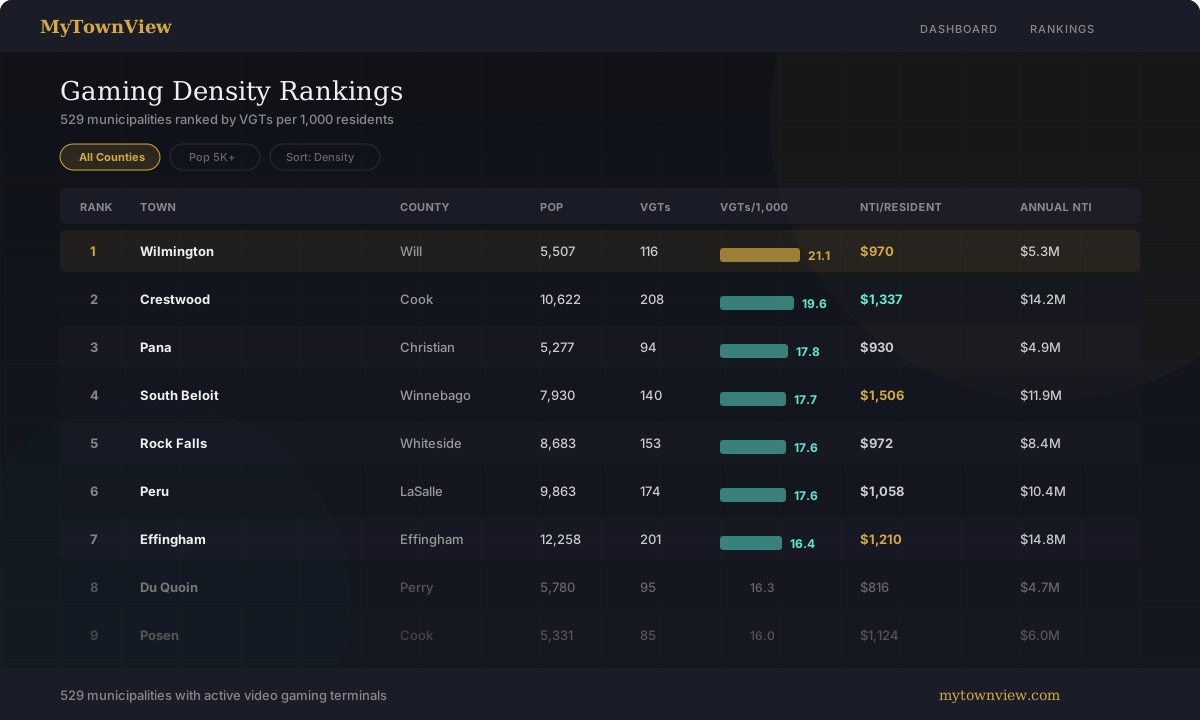
Illinois has nearly 50,000 video gaming terminals across the state. We analyzed the 529 municipalities where they operate to see which towns are the most saturated.
Since the first video gaming terminals went live in Illinois in September 2012, the industry has exploded. Statewide, players lost $3.2 billion in net terminal income in 2025 across roughly 9,000 bars, restaurants, gas stations, truck stops, and gaming cafes. Municipal governments collected over $150 million as their statutory share.
But the spread is wildly uneven. Of Illinois's roughly 1,300 municipalities, more than 700 have no video gaming at all, either banning terminals outright or never opting in. We analyzed 12 months of Illinois Gaming Board data (February 2025 through January 2026) across the 529 municipalities with active gaming to measure video gambling density and revenue per resident.
The 25 Most Gambling-Dense Towns
Only municipalities with populations over 5,000 are included. VGTs/1,000 measures terminal density. NTI/Resident shows how much money flows through machines relative to town size.
| Rank | Town | County | Pop | VGTs | VGTs/1,000 | NTI/Resident |
|---|---|---|---|---|---|---|
| 1 | Wilmington | Will | 5,507 | 116 | 21.1 | $970 |
| 2 | Crestwood | Cook | 10,622 | 208 | 19.6 | $1,337 |
| 3 | Pana | Christian | 5,277 | 94 | 17.8 | $930 |
| 4 | South Beloit | Winnebago | 7,930 | 140 | 17.7 | $1,506 |
| 5 | Rock Falls | Whiteside | 8,683 | 153 | 17.6 | $972 |
| 6 | Peru | LaSalle | 9,863 | 174 | 17.6 | $1,058 |
| 7 | Effingham | Effingham | 12,258 | 201 | 16.4 | $1,210 |
| 8 | Du Quoin | Perry | 5,780 | 95 | 16.3 | $816 |
| 9 | Posen | Cook | 5,331 | 85 | 16.0 | $1,124 |
| 10 | Summit | Cook | 10,896 | 171 | 15.7 | $1,161 |
| 11 | Mendota | LaSalle | 6,915 | 108 | 15.7 | $738 |
| 12 | Monee | Will | 5,104 | 80 | 15.7 | $940 |
| 13 | North Riverside | Cook | 7,495 | 111 | 14.8 | $1,512 |
| 14 | Countryside | Cook | 6,294 | 91 | 14.5 | $1,226 |
| 15 | Crete | Will | 8,382 | 118 | 14.1 | $858 |
| 16 | Fox Lake | Lake | 10,872 | 152 | 13.9 | $783 |
| 17 | Litchfield | Montgomery | 6,814 | 94 | 13.7 | $918 |
| 18 | Rochelle | Ogle | 9,477 | 130 | 13.7 | $796 |
| 19 | Ottawa | LaSalle | 18,714 | 254 | 13.6 | $772 |
| 20 | Wood River | Madison | 10,315 | 136 | 13.2 | $779 |
| 21 | Sterling | Whiteside | 14,670 | 185 | 12.6 | $693 |
| 22 | Johnsburg | McHenry | 6,374 | 80 | 12.6 | $880 |
| 23 | Roscoe | Winnebago | 10,881 | 136 | 12.5 | $1,006 |
| 24 | Spring Grove | McHenry | 5,866 | 73 | 12.5 | $647 |
| 25 | Chillicothe | Peoria | 6,185 | 77 | 12.4 | $601 |
Wilmington tops density at 21.1 VGTs per 1,000 residents, roughly one slot machine for every 47 people including children. The Will County village sits near an I-55 exit between Chicago and Bloomington, pulling highway traffic from the historic Route 66 corridor.
But density and revenue don't always line up. South Beloit is 4th in density but generates $1,506 in NTI per resident, more than any other town on this list. It sits on the Wisconsin border, where video gambling is prohibited, pulling players from across the state line. North Riverside is 13th in density but 2nd in revenue per resident at $1,512, driven by its position as a west suburban commercial hub along Harlem Avenue.
Location matters. Many top towns sit along major highways or state borders. Effingham sits at the junction of I-57 and I-70, a major freight interchange carrying 45,000+ vehicles daily. These towns pull players from far beyond their population base, which is why their per-resident revenue numbers can exceed $1,000.
Where Machines Earn the Most
Not all terminals are created equal. Some towns have fewer machines but much higher revenue per terminal. This measures how "hot" the machines are in a given town.
| Town | County | Pop | VGTs | NTI/Terminal | Annual NTI |
|---|---|---|---|---|---|
| Rolling Meadows | Cook | 23,981 | 37 | $154K | $5.6M |
| Norridge | Cook | 15,177 | 88 | $152K | $13.4M |
| Westchester | Cook | 16,524 | 42 | $149K | $6.3M |
| Willowbrook | DuPage | 9,138 | 36 | $143K | $5.2M |
| Orland Hills | Cook | 6,758 | 36 | $142K | $5.1M |
| Stickney | Cook | 6,957 | 66 | $138K | $9.1M |
| Morton Grove | Cook | 24,687 | 62 | $134K | $8.3M |
| Niles | Cook | 30,262 | 166 | $119K | $19.7M |
| Homer Glen | Will | 24,516 | 105 | $118K | $12.4M |
| Mokena | Will | 19,906 | 124 | $115K | $14.2M |
Rolling Meadows leads at $154,000 in annual NTI per terminal. That's more than double what many downstate terminals bring in. The pattern is clear: Cook County machines earn significantly more per unit than machines elsewhere in the state, likely reflecting higher population density and disposable income in the surrounding area.
Niles is notable for combining high volume with high per-terminal revenue: 166 terminals each generating $119K, for a total of $19.7M. That's the highest raw NTI of any town on this list.
Fastest Growing Gaming Towns
These towns saw the biggest year-over-year increase in NTI from the prior 12-month period. Only towns with over $1M in prior-year NTI are included to filter out noise from new entrants.
| Town | County | Pop | Prior Year | Current Year | Growth |
|---|---|---|---|---|---|
| Minooka | Grundy | 12,632 | $2.1M | $2.9M | +42% |
| Hillside | Cook | 8,133 | $2.8M | $3.9M | +38% |
| Harwood Heights | Cook | 8,851 | $7.1M | $9.6M | +35% |
| West Chicago | DuPage | 25,434 | $2.1M | $2.6M | +26% |
| Lockport | Will | 26,228 | $8.4M | $10.6M | +25% |
| Round Lake | Lake | 18,588 | $4.1M | $5.1M | +24% |
| Plano | Kendall | 11,626 | $4.2M | $5.1M | +23% |
| Lemont | Cook | 17,643 | $10.3M | $12.6M | +22% |
| Bloomingdale | DuPage | 22,388 | $3.2M | $3.9M | +22% |
| River Grove | Cook | 10,482 | $8.5M | $10.2M | +21% |
Harwood Heights jumped 35% to $9.6M in annual NTI, a striking number for a town of 8,851 people. That works out to over $1,000 per resident flowing through gaming machines.
Lockport and Lemont are both growing fast in Will County and south Cook, adding new establishments and seeing higher per-terminal revenue. The industry is still expanding in the collar counties.
The Other End: Towns With Barely Any Gaming
Not every community with video gambling has embraced it heavily. Among towns over 10,000 that do allow it:
| Town | County | Pop | VGTs | VGTs/1,000 | NTI/Resident |
|---|---|---|---|---|---|
| Downers Grove | DuPage | 49,867 | 6 | 0.1 | $9 |
| Morton | Tazewell | 16,503 | 6 | 0.4 | $26 |
| Edwardsville | Madison | 26,543 | 18 | 0.7 | $45 |
| Park Forest | Cook | 20,898 | 16 | 0.8 | $49 |
| Palatine | Cook | 66,548 | 64 | 1.0 | $69 |
| Aurora | Kane | 179,867 | 175 | 1.0 | $45 |
Downers Grove has exactly one gaming establishment with six machines for a town of nearly 50,000. Its NTI per resident is $9. Compare that to South Beloit's $1,506. Aurora, the state's second-largest city, has just 1.0 VGT per 1,000 people.
And many towns still ban video gaming entirely. Under the Video Gaming Act, municipalities have local option authority to allow or prohibit terminals. Among municipalities over 10,000 in our data, 74 have zero gaming revenue. Some never opted in. Naperville, Evanston, and several other large suburbs prohibit video gambling outright.
Think Your Town Has Too Much Gambling?
It's a common complaint at village board meetings: "There are too many gaming places in town." And it might feel that way when you pass a few on your daily commute. But feelings and data often tell very different stories.
Take Villa Park in DuPage County. With 29 gaming establishments, residents regularly push back on new license applications. Here's how Villa Park compares to its DuPage County neighbors:
| Town | Pop | VGTs | VGTs/1,000 | NTI/Resident | Municipal Share |
|---|---|---|---|---|---|
| Oakbrook Terrace | 2,714 | 119 | 43.8 | $5,157 | $709K |
| Villa Park | 22,456 | 164 | 7.3 | $641 | $729K |
| Wood Dale | 13,926 | 85 | 6.1 | $364 | $257K |
| Addison | 35,470 | 176 | 5.0 | $450 | $807K |
| Roselle | 22,731 | 104 | 4.6 | $375 | $431K |
| Lombard | 43,722 | 58 | 1.3 | $90 | $200K |
| Downers Grove | 49,867 | 6 | 0.1 | $9 | $21K |
Villa Park is the second most gaming-dense town in DuPage County, behind only Oakbrook Terrace (a commercial corridor with a small residential population that skews its per-capita numbers). At 7.3 VGTs per 1,000, Villa Park has a higher density than Addison, Wood Dale, Roselle, and Lombard. Its 164 terminals across 28 establishments generate $14.4M in annual NTI, putting it in the same revenue tier as Addison despite having 13,000 fewer residents.
So are Villa Park residents wrong to feel like gaming is everywhere? Not really. Within DuPage, their town does stand out. Statewide, Villa Park ranks 73rd out of 208 towns with populations over 5,000. That's in the top 35%, above average but well below the top 25 threshold of 12.4 VGTs per 1,000. The most gaming-dense towns in Illinois are running at 2-3x Villa Park's rate.
The terminal count has been steady. Villa Park averaged 159-165 terminals per month over the past year, up slightly from 150 two years ago. That growth came from a handful of new establishments, not a dramatic expansion. Its $729K municipal share works out to about $32 per resident per year, modest compared to the $77/resident that towns like North Riverside collect.
This pattern repeats across the suburbs. Towns where gaming is a hot-button political issue often turn out to have modest density numbers compared to the statewide picture. The difference is visibility: a gaming cafe on your block feels like a lot, even when the per-capita numbers say otherwise.
Where the Money Goes
When a player loses at a video gaming terminal, the loss (called net terminal income, or NTI) gets split by state law. The state takes 35% of NTI as a gaming tax. Out of that 35%, municipalities receive 5% of the total NTI automatically, no negotiation needed. The terminal operator and the establishment split the remaining 65%.
Some towns also charge local licensing fees on top of the statutory share. But the base municipal cut is set by the state.
For some smaller towns, the gaming share is real budget money:
| Town | Pop | Municipal Share | Per Resident |
|---|---|---|---|
| North Riverside | 7,495 | $574K | $77 |
| South Beloit | 7,930 | $605K | $76 |
| Crestwood | 10,622 | $719K | $68 |
| Stickney | 6,957 | $462K | $66 |
| Countryside | 6,294 | $391K | $62 |
| Effingham | 12,258 | $752K | $61 |
| Summit | 10,896 | $641K | $59 |
| Posen | 5,331 | $303K | $57 |
| Harwood Heights | 8,851 | $484K | $55 |
| Peru | 9,863 | $529K | $54 |
These aren't huge numbers in absolute terms, but for a village of 5,000 or 10,000 people, an extra $300K-$750K per year buys real services.
The County View
Raw terminal counts favor big counties. Cook has 8,246 VGTs, but it also has 1.7 million people across 92 gaming towns. Per capita tells a different story:
| County | Towns | Combined Pop | VGTs/1,000 | NTI/Resident | Annual NTI |
|---|---|---|---|---|---|
| Kankakee | 8 | 50,663 | 8.7 | $507 | $25.7M |
| St. Clair | 10 | 88,819 | 7.1 | $490 | $43.5M |
| Tazewell | 11 | 76,305 | 6.2 | $383 | $29.2M |
| McHenry | 21 | 199,895 | 5.6 | $343 | $68.6M |
| Winnebago | 7 | 203,606 | 5.2 | $407 | $82.9M |
| Madison | 13 | 111,051 | 5.5 | $327 | $36.3M |
| Cook | 92 | 1,715,660 | 4.8 | $399 | $685.0M |
| Lake | 25 | 382,277 | 4.8 | $383 | $146.5M |
| Will | 21 | 443,586 | 4.8 | $359 | $159.4M |
| DuPage | 18 | 442,415 | 3.5 | $308 | $136.4M |
| Kane | 21 | 527,117 | 2.7 | $213 | $112.5M |
Kankakee County leads at 8.7 VGTs per 1,000 residents and $507 in NTI per resident, nearly double Cook County's density rate. St. Clair County (East St. Louis metro) is second in density at 7.1 but close to Kankakee in revenue per resident at $490. Winnebago is interesting: just 7 municipalities with gaming, but $407 in NTI per resident, higher than Cook, driven by the South Beloit and Roscoe corridor pulling Wisconsin players across the border.
The collar counties that dominate in raw numbers (Cook, Will, Lake, DuPage, Kane) all fall in the middle or lower end per capita.
The Bigger Picture
ProPublica and WBEZ Chicago documented many of these patterns in their investigative series The Bad Bet, which found that VGT density tends to be higher in lower-income communities. Our data is consistent with that finding. Most of the towns in our top 25 are working-class communities. The wealthiest suburbs tend to either ban video gambling or allow very few terminals.
Whether gaming density is a net positive (local revenue, jobs) or net negative (addiction, social costs) depends on who you ask. What the data shows clearly is how unevenly the industry is distributed, and how some communities have built it into a significant part of their economic identity.
Explore Your Town's Gaming Data
Every municipality on MyTownView with video gaming has a detailed breakdown on its town page, including monthly revenue trends, establishment-level data, terminal counts, and the municipality's gaming share. Browse for free at mytownview.com/states.
Want to compare your town's gaming density against neighboring communities? The Dashboard Compare tool lets you put up to five towns side by side across gaming and 100+ other metrics. The Rankings table lets you sort every municipality by gaming revenue, density, or municipal share to see exactly where your town falls statewide. Both are available with a 14-day free trial.
Methodology
- Data source: Illinois Gaming Board monthly video gaming terminal revenue reports
- Time period: February 2025 through January 2026 (12 months)
- Primary metric: Average monthly VGT count per 1,000 residents
- Population source: U.S. Census Bureau, American Community Survey (2023 estimates)
- Minimum population: 5,000 for the main ranking
- Coverage: 529 municipalities with active video gaming terminals (out of ~49,000 VGTs statewide across ~9,000 locations including unincorporated areas)
- NTI (Net Terminal Income): Amount played minus amount won. This is the total amount players lose, before it gets split between the state, municipality, terminal operator, and establishment.
- NTI per resident: Total annual NTI divided by population. This does not mean residents are losing this amount. Towns near highways, state borders, or commercial corridors pull players from outside their population base.
- NTI per terminal: Total annual NTI divided by average monthly terminal count. Measures how much revenue each machine generates.
- Municipal share: 5% of NTI, set by state law under the Video Gaming Act (230 ILCS 40). Some municipalities charge additional local licensing fees.
- VGT limits: Standard establishments may operate up to 6 terminals; licensed large truck stops up to 10.
- Year-over-year growth: Compares the 12 months ending January 2026 to the 12 months ending January 2025. Only towns with $1M+ in prior-year NTI are included.